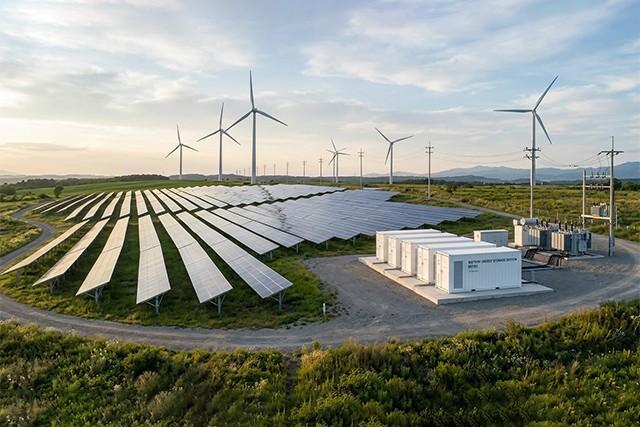
Battery storage is quickly becoming one of the most important pieces of Southeast Asia’s energy transition. As solar and wind capacity grows, batteries can help turn variable renewable power into electricity that is more reliable, flexible and available when consumers need it.
Southeast Asia’s clean-energy transition is accelerating
Southeast Asia is entering a period of rapid growth in electricity demand.
Economic expansion, industrialisation, electrification, data centres and rising living standards are all increasing the amount of electricity the region needs. At the same time, governments are looking to expand renewable energy and reduce dependence on fossil fuels.
Solar and wind are becoming increasingly attractive because they can be deployed relatively quickly and help countries reduce emissions.
But renewable generation comes with a fundamental challenge.
The sun does not always shine when electricity demand is highest, and the wind does not always blow when the grid needs additional power.
That is where battery storage becomes important.
Battery storage makes renewable energy more flexible
Battery energy storage systems can store electricity when supply is high and release it when demand increases.
For example, a solar project may produce its greatest amount of electricity around midday, while households and businesses may consume more electricity later in the afternoon or evening.
Without storage, some of that solar generation may have to be curtailed or used immediately.
With batteries, excess electricity can be stored and released later.
This allows renewable energy to play a larger role in the electricity system without requiring every unit of generation and consumption to occur at exactly the same time.
In simple terms, batteries help move renewable electricity from when it is available to when it is needed.
The grid needs more flexibility
Southeast Asia's electricity networks were largely designed around conventional power generation that could be scheduled according to demand.
A system with large amounts of solar and wind works differently.
Renewable output can change rapidly because of weather conditions, while electricity demand can also rise quickly as economies become more digital and electrified.
Battery storage can provide several services to the grid, including frequency regulation, balancing, peak demand management and backup power.
This flexibility becomes increasingly valuable as the share of variable renewable energy increases.
Battery storage can strengthen energy security
Energy security is another reason storage matters.
Many Southeast Asian economies remain exposed to imported fuels and international energy prices. Disruptions to fuel supply or sudden price increases can place pressure on electricity systems and consumers.
Storage does not eliminate those risks, but it can give electricity systems another layer of resilience.
When combined with domestic solar and wind generation, batteries can help countries use more locally produced electricity and reduce reliance on fossil-fuel generation during periods of high demand.
For island and remote systems, the potential can be even greater.
Battery storage paired with renewable generation can help reduce the need for expensive diesel generation and improve the reliability of local electricity supply.
Data centres and new electricity demand
The growth of digital infrastructure is creating another reason to invest in flexible electricity systems.
Data centres, semiconductor facilities, industrial parks and other high-value facilities require reliable electricity around the clock.
Southeast Asia is attracting significant investment in these sectors, particularly in markets such as Singapore, Malaysia, Indonesia and Thailand.
As electricity demand from digital infrastructure grows, power systems will need to balance reliability with the increasing deployment of renewable energy.
Battery storage can help provide additional flexibility and backup capacity while allowing renewable generation to contribute more significantly to the electricity mix.
Storage is not just about backup power
It is easy to think of batteries simply as emergency backup systems.
Their role is much broader.
Large-scale battery systems can help electricity markets manage periods of high demand, reduce renewable-energy curtailment and provide services that help maintain grid stability.
They can also be paired directly with solar projects, allowing developers to build renewable plants that can deliver electricity beyond the hours of peak solar production.
For utilities and grid operators, this flexibility can become increasingly valuable as electricity systems become more complex.
Southeast Asia's opportunity
The region is at an important stage of its energy transition.
Countries have different electricity markets, grid structures, renewable resources and policy frameworks, so there is no single storage model that will work everywhere.
Some markets may prioritise utility-scale batteries.
Others may see stronger demand for commercial and industrial storage, residential batteries, microgrids or renewable projects combined with storage.
The opportunity is therefore not simply about installing more batteries.
It is about designing electricity systems in which generation, transmission, storage and demand can work together.
The investment challenge
Battery storage is becoming more commercially attractive, but large-scale deployment still requires investment and supportive market rules.
Developers need clear revenue models that recognise the different services batteries can provide.
Regulators also need to determine how storage assets should participate in electricity markets and how they should be connected to the grid.
Financing, land availability, grid connections and battery supply chains will also influence how quickly projects can be developed.
The countries that establish clear frameworks for storage could be better positioned to attract investment as renewable deployment accelerates.
The bigger picture
Southeast Asia's energy transition is no longer simply a question of building more solar panels and wind turbines.
The bigger challenge is creating an electricity system capable of absorbing those resources reliably.
That means investing in transmission, modernising grids, improving demand management and building sufficient energy storage.
Battery storage will not solve every challenge facing the region's electricity systems.
But it can provide one of the most important pieces of flexibility needed to connect a larger amount of renewable energy to the grid.
The Energy Insider Asia view
Battery storage should increasingly be viewed as core energy infrastructure rather than an optional technology.
As Southeast Asia's electricity demand rises and renewable generation expands, the ability to store and shift electricity will become increasingly valuable.
The winners of the region's clean-energy transition will not necessarily be the countries that build the most renewable capacity.
They may be the countries that successfully build the grids, storage and market systems needed to make that renewable capacity useful when consumers need it most.
Sources
International Energy Agency — Southeast Asia Energy Outlook 2024
Asian Development Bank — ASEAN Power Grid
International Renewable Energy Agency — Flexibility for a Secure and Affordable Power Sector Transformation (2026)
Asian Development Bank — Accelerating Battery Energy Storage System Development in the Asia and Pacific Region
Asian Development Bank — Cambodia Utility-Scale Battery Energy Storage Project
Asian Development Bank — Thailand Solar + Battery Energy Projects (2026)