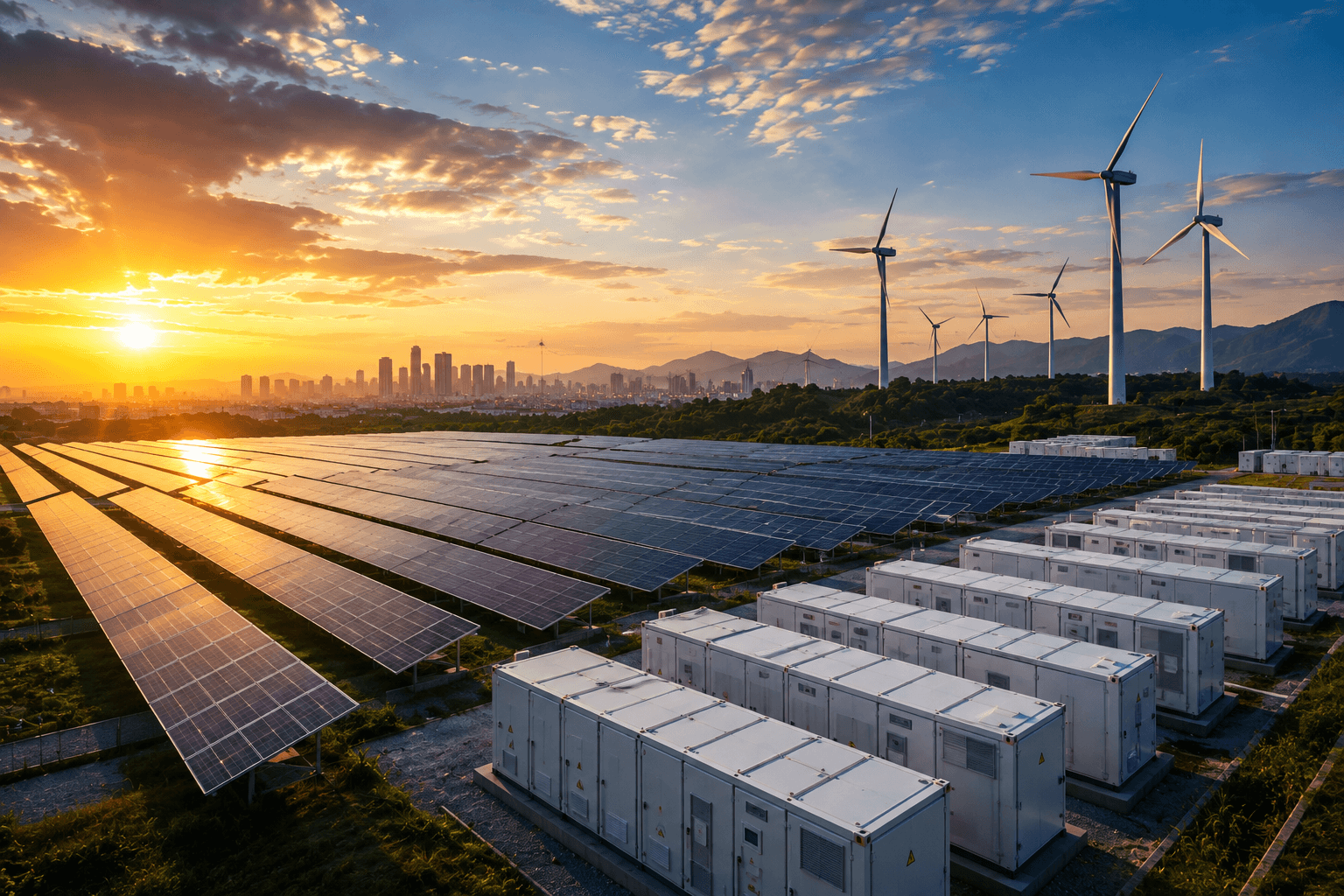
The race is no longer about whether Asia will build more renewable energy. It is about how quickly it can do so.
Across Asia, the economics of electricity are changing.
Solar panels are becoming easier to deploy. Battery storage is expanding. Electricity demand is rising. And governments, businesses and households are increasingly looking for alternatives to imported fossil fuels.
The result is a renewable-energy race that is becoming as much about energy security and economics as it is about decarbonisation.
From rooftop solar in the Philippines to large-scale batteries and renewable generation in Australia, the region is moving toward a more diverse electricity system.
But building the generation is only one part of the challenge.
Solar is moving closer to the consumer
The Philippines offers one of the clearest examples of how quickly renewable energy can move from policy ambition to consumer demand.
Electricity prices have risen sharply, while the country remains exposed to imported fuel costs. That has encouraged households and businesses to look at rooftop solar as a way of reducing their exposure to higher power bills.
China is playing a major role in this expansion.
Chinese manufacturers supplied about 80 per cent of global solar production, and exports of solar panels to the Philippines more than doubled in the first five months of 2026 compared with the same period a year earlier.
The scale of demand is significant.
The Philippines became China’s largest overseas solar-panel market in 2026, while Chinese panel shipments to the country reached more than US$500 million during the first part of the year.
For consumers, the attraction is relatively straightforward: cheaper solar technology can provide an alternative to increasingly expensive grid electricity.
For manufacturers, Southeast Asia provides something equally important — a rapidly expanding market at a time when China's enormous solar industry is dealing with excess production capacity.
The rooftop solar boom is only the beginning
The Philippines shows how renewable energy can spread from utility-scale projects into homes, businesses and smaller commercial installations.
But rooftop solar also exposes one of the biggest issues facing Asia's energy transition.
Panels alone do not create a reliable electricity system.
Solar generation changes throughout the day and disappears at night. As more solar enters the grid, countries need batteries, flexible generation, stronger transmission networks and smarter demand management.
That means the next stage of Asia's renewable-energy race will increasingly be about building an entire energy system around renewable generation.
Australia is becoming a test case for batteries
Australia provides another important example.
The country has traditionally relied heavily on coal, but renewable energy accounted for 42.7 per cent of its electricity generation in 2025, according to figures cited by OilPrice.
Wind, rooftop solar, utility-scale solar and hydropower are increasingly taking a larger role in the electricity mix.
At the same time, battery deployment is accelerating.
Home battery sales in Australia rose 260 per cent between 2024 and 2025, while large-scale battery capacity increased 233 per cent over the same period. Almost 270,000 home batteries were purchased in 2025.
That matters because batteries solve a problem that solar alone cannot.
They allow electricity generated when the sun is shining to be stored and used later, helping smooth the variability of renewable generation.
Australia has also become one of the world's largest utility-scale battery markets, demonstrating how quickly storage can become a core component of a modern power system.
The next bottleneck is the grid
This is where Asia's renewable-energy race becomes more complicated.
Adding solar panels and wind turbines is relatively visible. Building the infrastructure required to connect them is much harder.
Transmission networks need to be expanded.
Distribution systems need to become more flexible.
Battery storage needs to be deployed in the right locations.
And electricity markets need to evolve so that consumers and generators can respond to changing supply and demand.
A country can have an enormous pipeline of renewable projects and still struggle to deliver clean electricity if the grid cannot absorb the new generation.
That is why the renewable-energy story is increasingly becoming a grid story.
China is supplying the technology. Asia is supplying the demand.
One of the defining characteristics of Asia's energy transition is the role of China.
China has developed an enormous manufacturing base for solar panels and batteries, allowing other Asian economies to access renewable technologies at increasingly competitive prices.
The Philippines is already benefiting from this dynamic.
Chinese solar exports to the country more than doubled in the first five months of 2026, while demand has spread beyond Manila to regional centres such as Davao.
This creates a powerful regional feedback loop.
Lower technology costs make renewable energy more attractive.
Higher demand creates larger markets.
Larger markets encourage investment.
And greater manufacturing scale can further reduce costs.
But it also creates questions around supply-chain concentration, trade policy and the long-term development of domestic clean-energy industries.
Renewable energy is becoming an energy-security strategy
There is another reason the transition is accelerating.
Energy security.
For countries that rely heavily on imported oil, gas or coal, renewable generation offers a way to produce more electricity from domestic resources.
The Philippines is a good example. Rising electricity costs and exposure to imported fossil-fuel prices have increased the incentive for households and businesses to consider solar.
Australia is approaching the transition from a different starting point, but the underlying objective is similar: create a more diversified electricity system while reducing dependence on ageing coal infrastructure.
Across Asia, this logic is likely to become increasingly important.
The renewable-energy transition is no longer simply about meeting emissions targets.
It is also about controlling electricity costs, reducing exposure to international fuel markets and improving the resilience of national power systems.
The race will be won by systems, not individual technologies
Solar panels will be important.
So will wind farms.
But neither technology can carry Asia's energy transition alone.
The countries that move fastest are likely to be those that build the supporting infrastructure at the same time.
That means transmission.
It means batteries.
It means smarter electricity markets.
It means better forecasting and grid management.
And increasingly, it means connecting renewable generation with some of the region's fastest-growing sources of electricity demand, including data centres, manufacturing and electric transport.
The scale of the opportunity is enormous.
But so is the investment required.
Why this matters for Asia
Asia's electricity demand is rising at the same time that governments are trying to reduce emissions and improve energy security.
That creates a difficult balancing act.
More economic growth means more electricity demand.
More renewable generation means greater flexibility is required from the grid.
More batteries mean new investment in storage and network infrastructure.
And more distributed solar means electricity systems must become increasingly digital and responsive.
The renewable-energy race is therefore evolving into something much bigger.
It is a race to build the next generation of Asia's electricity system.
The Energy Insider Asia view
The most important question is no longer whether Asia will build more solar, wind and batteries.
It is whether the region can build the infrastructure around them quickly enough.
The Philippines shows how rapidly consumer demand can change when electricity becomes expensive.
Australia shows what happens when renewable generation and battery storage begin scaling together.
And across the wider region, the same forces are beginning to converge: rising electricity demand, cheaper clean-energy technology and a growing focus on energy security.
The winners will not necessarily be the countries that install the most solar panels.
They will be the countries that successfully connect generation, storage, transmission and demand into a reliable electricity system.
That is the real race behind Asia's renewable-energy future.
Sources
The Business Times — China is supercharging a rooftop solar boom in the Philippines, July 13, 2026. Read the source
OilPrice.com — Australia’s Clean Energy Boom Is Gathering Speed, July 26, 2026. Read the source