When people talk about electric vehicles, the conversation often focuses on passenger cars.
But Asia's mobility transition is much broader.
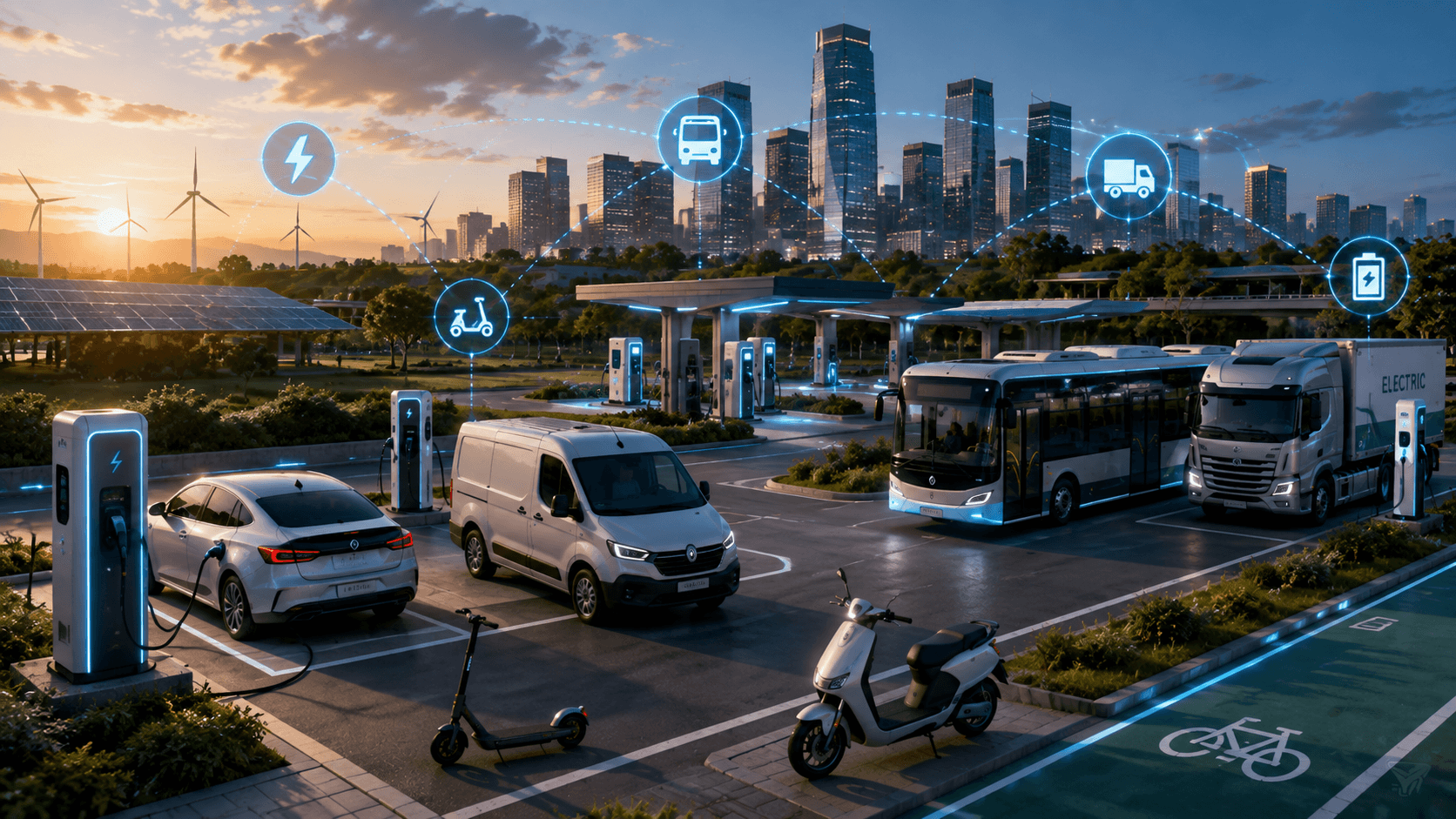
Electric buses, delivery vans, trucks, motorcycles, scooters and three-wheelers are all becoming part of the changing transport system.
That matters because each type of vehicle has different driving patterns, charging needs and implications for the electricity grid.
Two-wheelers are particularly important in Asia
In many Asian markets, motorcycles and scooters are central to everyday transportation.
Electrifying these vehicles can therefore have a significant impact even if passenger-car ownership remains relatively low.
Electric two- and three-wheelers generally require less energy per vehicle than cars, but their sheer numbers can make them an important part of the region's overall electrification story.
Fleets could move faster than private cars
Commercial fleets are another major opportunity.
Delivery vehicles, buses, taxis and company vehicles often follow predictable routes and return to a central depot.
That makes them easier to plan around than privately owned vehicles.
A fleet operator can install charging infrastructure at a depot and schedule charging around vehicle operating requirements and electricity prices.
This creates an opportunity to optimise both transport and electricity costs.
Charging is the real infrastructure challenge
An electric vehicle does not simply need a battery.
It needs somewhere to charge.
That can mean:
Home charging
Workplace charging
Public charging
Highway fast charging
Fleet depots
Bus charging facilities
Commercial charging hubs
Different users need different solutions.
A homeowner with a private parking space may rarely need public charging.
A taxi driver or delivery fleet may depend heavily on fast charging.
The charging network therefore needs to be designed around how vehicles are actually used, not simply how many vehicles are sold.
The IEA says public charging infrastructure is becoming increasingly important as EV adoption expands, with global public charging points exceeding five million by 2024.
Fast charging is not always the answer
It can be tempting to think that faster chargers are always better.
But charging speed comes with higher infrastructure and grid requirements.
For vehicles that remain parked for several hours, slower charging may be perfectly adequate.
A bus depot, for example, may be able to charge vehicles overnight.
A highway charging station has a different requirement because drivers may only stop for a short period.
The best charging system is therefore the one that matches vehicle use, parking time and electricity availability.
EVs are also an electricity-system issue
Millions of electric vehicles will eventually represent a significant source of electricity demand.
The challenge is not necessarily the total amount of electricity.
It is when that electricity is consumed.
If large numbers of vehicles begin charging at exactly the same time, they could create new peaks in electricity demand.
But if charging can be shifted to periods when demand is lower or renewable generation is abundant, EVs can become more grid-friendly.
This is where smart charging becomes important.
What is smart charging?
Smart charging allows the timing or rate of EV charging to be adjusted according to conditions such as electricity prices, grid demand or renewable generation.
Instead of every vehicle immediately charging at maximum power, charging can be coordinated.
For example:
A fleet could charge more heavily overnight.
A home charger could delay charging until solar generation is available.
A utility could encourage customers to charge during periods of lower system demand.
This turns EV charging from a completely passive electricity load into a potentially flexible resource.
What about vehicle-to-grid?
The next step is vehicle-to-grid, or V2G.
Instead of only taking electricity from the grid, compatible vehicles can potentially send electricity back.
That means an EV battery could become a temporary source of electricity for a building or the wider grid.
The technology is still developing, and widespread deployment requires compatible vehicles, chargers, communications systems, market rules and appropriate customer incentives.
But the concept illustrates how transport and electricity systems are becoming increasingly interconnected.
The IEA identifies smart charging and vehicle-to-grid integration as technologies that could help EVs provide benefits to electricity systems, although market structures and legal frameworks are needed to realise that potential.
EVs will increase electricity demand
Electrifying transport does increase electricity consumption.
The IEA estimates that the global EV fleet consumed around 180 TWh of electricity in 2024, and under its stated-policies scenario, EV electricity demand could reach around 780 TWh by 2030.
That makes transport an increasingly important part of electricity planning.
The answer is not to avoid electrification.
It is to make sure electricity networks, generation, charging infrastructure and demand-management systems develop alongside it.
The mobility ecosystem is changing
The EV transition is creating new businesses and infrastructure around transportation.
Charging operators, fleet-management platforms, battery providers, electricity retailers, utilities and vehicle manufacturers increasingly have to work together.
This creates a much larger ecosystem than simply selling electric cars.
For cities, it also creates new questions around parking, charging access, electricity tariffs and public infrastructure.
The Energy Insider Asia view
The EV transition should not be measured simply by how many electric cars are sold.
The bigger transformation is happening across the entire mobility and electricity ecosystem.
Two-wheelers, buses, trucks and commercial fleets will all play a role.
Charging infrastructure will determine how convenient electrification becomes.
And smart charging could determine how well millions of new electricity loads interact with the grid.
The future of electric mobility is therefore also part of the future of the power system.
Sources
International Energy Agency — Global EV Outlook 2025
International Energy Agency — Electric Vehicle Charging — Global EV Outlook 2025
International Energy Agency — Outlook for Energy Demand — Global EV Outlook 2025
International Renewable Energy Agency — Demand-side flexibility for power sector transformation
International Renewable Energy Agency — Smart Electrification with Renewables