Japan
Japan is rebuilding its energy system around security and decarbonisation
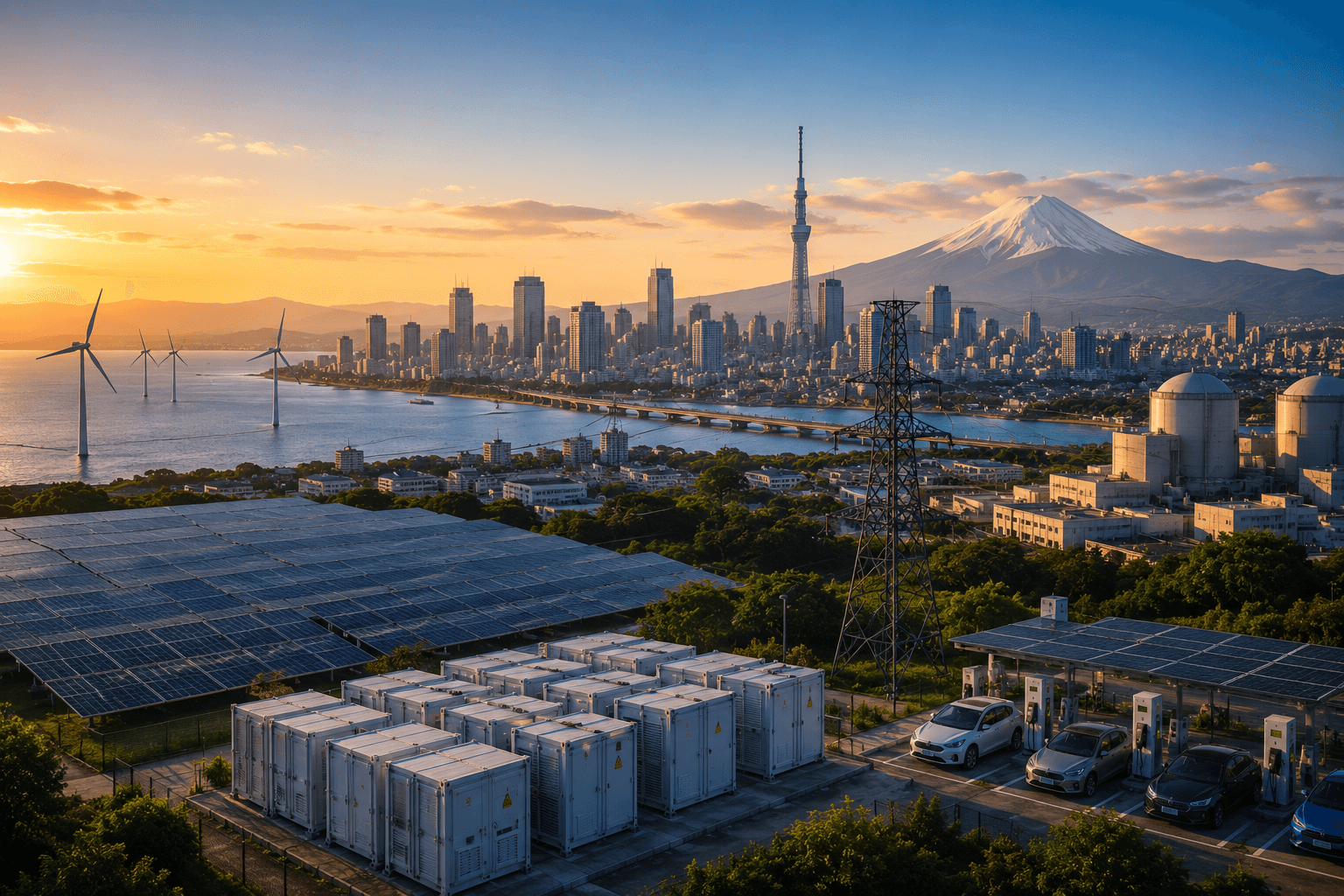
Japan is accelerating its energy transition through renewables, nuclear restarts, hydrogen, storage and grid investment, while putting energy security and industrial competitiveness at the centre of its GX strategy.
Japan is entering a new phase of its energy transition.
After the disruption to its energy system following the Fukushima accident, Japan is now placing greater emphasis on nuclear power alongside renewables.
The government's latest energy plan calls for maximum introduction of renewable energy while also restoring nuclear power's role as a major source of low-carbon electricity. By FY2040, renewables are expected to provide 40–50% of electricity and nuclear around 20%.
At the same time, Japan expects electricity demand to increase as industries electrify and new demand emerges from areas such as data centres, semiconductor manufacturing and advanced manufacturing.
The result is a transition built around multiple technologies rather than renewables alone.
Policy & Targets
2030
Japan's existing FY2030 electricity-mix target includes:
36–38% renewables
20–22% nuclear
Around 20% LNG
Around 19% coal
Around 1% hydrogen/ammonia.
Japan's previous climate target was a 46% reduction in GHG emissions from FY2013 levels by FY2030.
2035
Japan's latest NDC targets:
60% reduction in GHG emissions from FY2013 levels by FY2035.
2040
Japan targets:
40–50% renewable electricity
20% nuclear
30–40% thermal generation
73% GHG emissions reduction from FY2013 levels.
2050
Net-zero greenhouse gas emissions.
Power Market
Japan's power market is undergoing a structural shift.
The country historically relied heavily on imported LNG, coal and oil, making energy security a major policy concern.
The new strategy is designed to diversify the power system through:
Renewables + Nuclear + LNG + Storage + Hydrogen/Ammonia
Nuclear is particularly important because Japan sees it as a source of stable, low-carbon electricity that can complement variable renewable generation.
The government expects electricity demand to rise substantially by FY2040, with generation projected at approximately 1.1–1.2 trillion kWh.
This makes Japan's transition partly a capacity-expansion story, not simply a decarbonisation story.
Grid & Storage
As Japan adds more solar and wind, grid flexibility becomes increasingly important.
Japan faces geographic constraints because its power system is divided between regional utilities and historically operated across different frequency systems in eastern and western Japan.
The country is therefore investing in:
Inter-regional transmission
Grid reinforcement
Battery storage
Pumped hydro
Demand response
Flexible generation
Digitalisation of the electricity system
Storage will become increasingly important as solar and wind penetration rises.
The key question is whether Japan can build enough flexibility and transmission to integrate significantly more variable renewable electricity without compromising reliability.
Industry & New Energy
Japan's energy transition is closely tied to its industrial strategy.
The GX strategy is designed to mobilise investment into sectors such as:
Hydrogen & ammonia
Batteries
Semiconductors
Steel
Chemicals
Automotive
Renewable energy
Carbon capture
Energy efficiency
Hydrogen and ammonia are particularly important because Japan sees them as potential tools for decarbonising sectors where direct electrification is difficult.
Japan is also positioning itself as a technology and financing hub for clean-energy supply chains across Asia.
What We're Watching
01 — Nuclear restarts
How quickly can Japan bring more existing nuclear capacity back online while maintaining safety and public confidence?
02 — Offshore wind
Can Japan overcome its deep-water and permitting challenges to build offshore wind at scale?
03 — Hydrogen & ammonia
Can hydrogen and ammonia become commercially competitive rather than remaining primarily policy-supported technologies?
04 — Grid flexibility
Will batteries, pumped hydro and transmission investment keep pace with renewable deployment?
05 — Data centres & semiconductors
How much additional electricity demand will Japan's semiconductor and data-centre expansion create?
06 — GX investment
Can Japan turn its large-scale GX investment programme into a competitive domestic clean-tech industry?
Energy Insider View
Japan's energy transition is fundamentally an energy-security story.
Unlike countries with abundant domestic renewable resources, Japan has limited land and relies heavily on imported fuels. That makes the country's transition more complex.
The emerging model is therefore not renewables replacing everything.
Instead, Japan is building a diversified low-carbon system combining renewables, nuclear, storage, hydrogen, ammonia and increasingly flexible grids.
The strategic opportunity is particularly interesting for Asia.
Japan has the capital, technology and industrial capabilities to become a major provider of clean-energy technologies, financing and infrastructure solutions across the region.
For Energy Insider Asia, Japan is one of the markets to watch for how advanced economies balance decarbonisation with energy security and industrial competitiveness.
Sources
METI / Agency for Natural Resources and Energy — 7th Strategic Energy Plan
Japan's official energy strategy and FY2040 electricity mix.Government of Japan — Japan's 2035–2040 NDC
Official emissions-reduction targets.IEA — Japan Energy Profile
Energy mix, electricity and energy-transition analysis.Agency for Natural Resources and Energy — Renewable Energy Strategy
Renewable deployment and FY2030 target.