Indonesia
Indonesia’s energy transition: balancing coal, growth and clean power
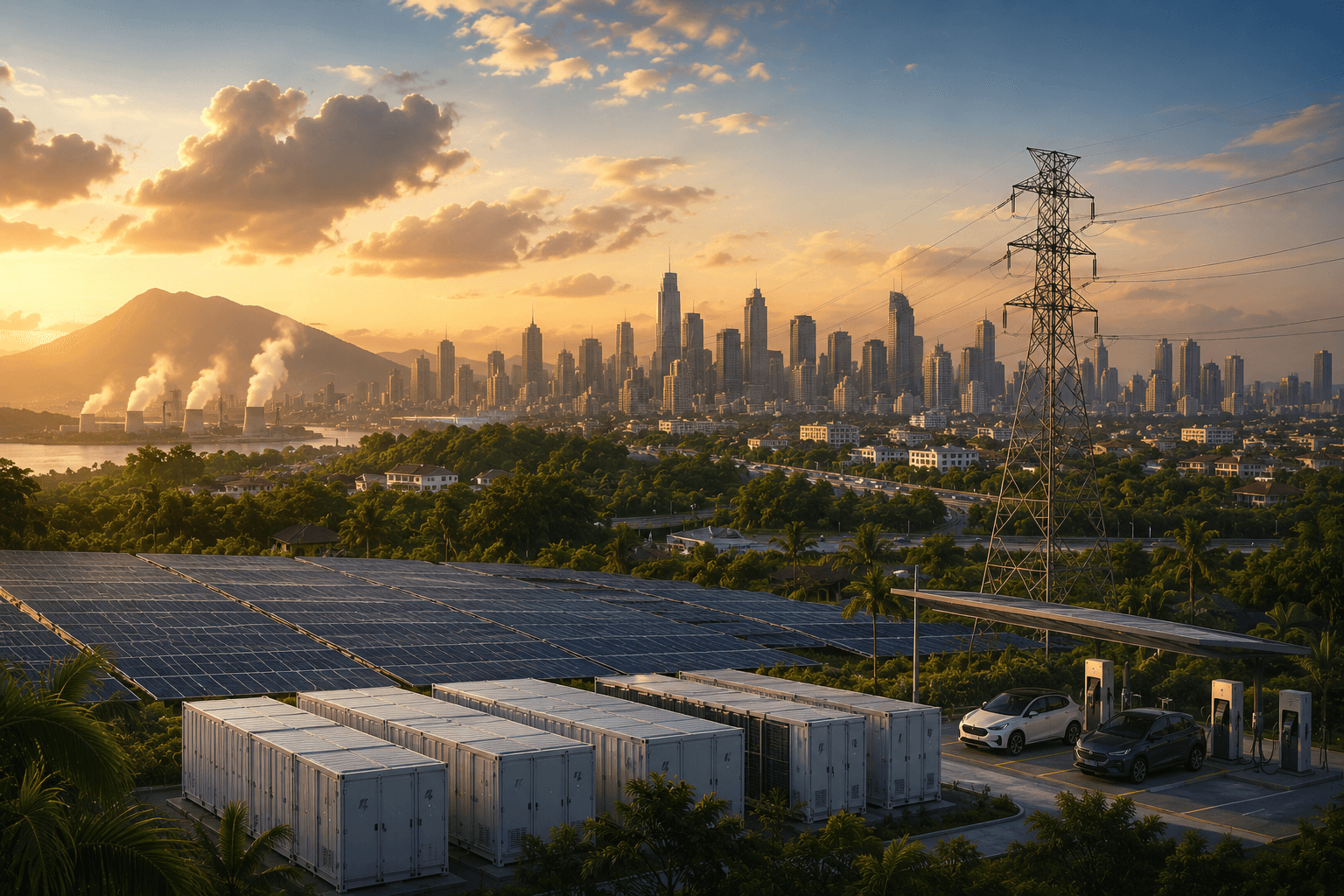
Indonesia is Southeast Asia’s largest energy market, where rapid industrial growth is colliding with the need to decarbonise a coal-heavy power system. The next phase of its transition will be shaped by renewables, grid expansion, energy storage and the growth of EV and battery industries.
Indonesia is attempting one of Asia's most complex energy transitions: decarbonising a power system that remains heavily dependent on coal while electricity demand rises and the country simultaneously builds energy-intensive industries such as nickel processing, batteries and EV manufacturing.
The direction of travel is increasingly clear. Indonesia's latest power plan puts renewables and storage at the centre of new capacity additions, but the transition will not be a rapid coal exit. Fossil fuels remain important to system reliability, industrial development and energy affordability.
Policy & Targets
Net Zero Emissions: Indonesia targets net zero emissions by 2060 or sooner.
2030 NDC: emissions reduction target of 31.89% below BAU unconditionally, rising to 43.20% with international support.
RUPTL 2025–2034: PLN plans 69.5 GW of additional generation capacity, with around 76% coming from renewables and energy storage.
The plan includes 42.6 GW of renewable generation and 10.3 GW of storage by 2034.
Indonesia is also pursuing energy security through B40 biodiesel, mandatory since January 2025.
Power Market
Indonesia's power market remains dominated by PLN, the state-owned electricity utility, while coal continues to provide the backbone of electricity generation.
Electricity demand is nevertheless rising. PLN recorded 317.69 TWh of electricity sales in 2025, a 3.75% increase from 2024. Industrial electricity consumption reached 93.35 TWh, while business-sector demand reached 60.74 TWh.
The challenge is therefore not simply replacing coal. Indonesia needs to add enough clean generation to meet new demand from industry, urbanisation, EVs, data centres and economic growth, while maintaining system reliability.
Grid & Storage
Grid infrastructure is becoming one of Indonesia's biggest energy-transition priorities.
Under RUPTL 2025–2034, the government plans almost:
48,000 km of transmission circuits
and approximately:
108,000 MVA of substation capacity.
The plan also includes:
6 GW pumped-storage hydro
4.3 GW battery energy storage systems
10.3 GW total storage
Large-scale solar, hydro, wind and geothermal additions
This is particularly important because Indonesia is an archipelago. Renewable resources and electricity demand are often located far apart, making transmission and system flexibility critical to scaling renewables.
Industry & New Energy
Indonesia's energy transition is closely linked to its industrial strategy.
The country is seeking to move beyond exporting raw minerals by developing domestic processing and manufacturing around nickel, batteries and electric vehicles. The government is accelerating an integrated EV-battery ecosystem, with projects spanning upstream nickel processing through to battery manufacturing.
This creates a major strategic question:
Can Indonesia build a globally competitive clean-energy supply chain using increasingly cleaner electricity?
The answer matters far beyond Indonesia because the country is already a major player in global nickel and battery-material supply chains. Reuters recently highlighted the growing importance of Indonesia and China in Asia's energy-mineral refining landscape.
What We're Watching
I'd make this section particularly useful for your Energy Insider Asia audience:
1. Coal dependency vs. renewable growth
Can Indonesia accelerate renewables while maintaining affordable and reliable electricity?
2. Grid build-out
Will PLN deliver the transmission infrastructure needed to connect the country's large renewable-energy pipeline?
3. Coal supply & reliability
Recent power disruptions have highlighted the importance of coal supply security and the vulnerabilities of a system heavily dependent on fossil fuels.
4. Nickel → batteries → EVs
Can Indonesia capture more value from its mineral resources by building a complete EV and battery ecosystem?
5. Solar and storage
Can Indonesia finally scale solar at the pace envisaged by its long-term power plans?
6. Private investment
RUPTL 2025–2034 opens significant opportunities for IPPs and private investors, with around 73% of planned generation capacity expected to involve private-sector/IPP participation.
Energy Insider View
Indonesia's transition is not a simple coal-to-renewables story.
It is a race between rising electricity demand, industrialisation and the need to decarbonise the power system.
The opportunity is enormous: Indonesia has major potential in solar, hydro, geothermal and wind, alongside some of the world's most important nickel resources.
But the critical test will be execution.
The next phase of Indonesia's energy transition will be decided by three things: renewables, grid infrastructure and the ability to make industrial growth progressively cleaner.
That is where Energy Insider Asia should keep watching.
Sources
Indonesia's Ministry of Energy and Mineral Resources (ESDM)
PLN
UNFCCC
International Energy Agency