India
India’s energy transition is scaling with its economy
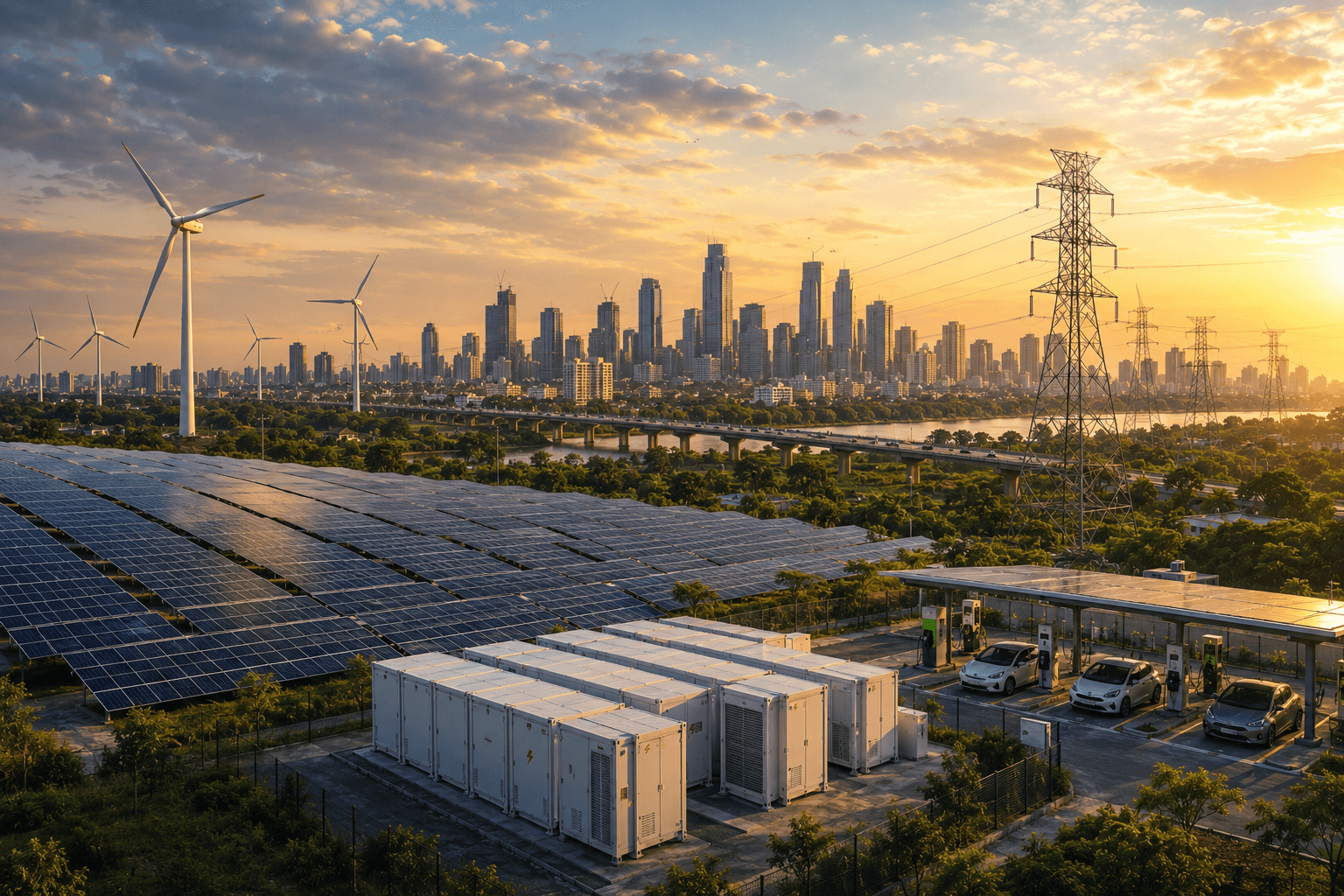
India is rapidly expanding solar, wind, storage and clean-energy manufacturing while electricity demand continues to rise. The challenge is balancing economic growth and energy security with a progressively lower-carbon power system.
India's energy transition is being driven by a powerful combination of economic growth, rising electricity demand and rapidly falling clean-energy costs.
Solar is becoming increasingly important to meeting incremental electricity demand, while wind, hydro, nuclear and storage provide additional sources of low-carbon and firm power.
The scale is already significant. India's renewable capacity reached almost 289 GW by June 2026, while the country is continuing to expand manufacturing across solar PV, batteries, green hydrogen and other clean technologies.
Yet coal remains critical to India's power system. The IEA expects coal to continue supplying a significant portion of India's growing electricity needs through 2030, even as solar PV becomes the fastest-growing source of generation.
India's transition is therefore less about abandoning conventional power overnight and more about adding clean capacity at extraordinary speed while keeping electricity reliable and affordable.
Policy & Targets
2030
500 GW non-fossil electricity capacity
50% of cumulative installed electricity capacity from non-fossil sources — achieved ahead of schedule in June 2025
45% reduction in GDP emissions intensity from 2005 levels
Continued expansion of renewable energy, storage, green hydrogen and domestic clean-tech manufacturing.
2035
India's new 2031–2035 NDC raises the ambition:
60% of cumulative installed electricity capacity from non-fossil sources
47% reduction in GDP emissions intensity from 2005 levels
3.5–4.0 billion tonnes CO₂-equivalent carbon sink through forest and tree cover.
2070
Net-zero emissions.
Power Market
India has one of the world's fastest-growing electricity markets.
Electricity demand is expected to grow by an average 6.4% annually through 2030, according to the IEA. Around half of the additional electricity demand through 2030 is expected to be met by solar PV, with coal still contributing around a quarter of incremental supply.
The structure of the market is changing rapidly:
Solar → fastest-growing generation source
Wind → expanding alongside solar
Hydro → important source of flexibility
Nuclear → growing strategic priority
Coal → remains central to reliability and demand growth
India is therefore building a multi-technology power system, rather than pursuing a single-source transition.
Grid & Storage
India's renewable expansion is increasingly creating a grid and flexibility challenge.
Solar and wind generation are geographically dispersed and variable, while India's major industrial and population centres continue to experience strong electricity-demand growth.
Energy storage is therefore becoming critical. India's Central Electricity Authority estimates that the system could require around 51–84 GW of 5-hour battery energy storage by 2031–32, alongside significant pumped-storage capacity.
The country is also expanding transmission infrastructure and grid-management capabilities to connect large renewable-energy zones with major demand centres.
The next bottleneck for India's renewable transition may increasingly be the grid rather than generation capacity.
Industry & New Energy
India is attempting to build a domestic clean-energy industrial ecosystem rather than relying entirely on imported technologies.
Key areas include:
Solar PV manufacturing
Battery manufacturing
Electric vehicles
Green hydrogen
Electrolysers
Power electronics
Energy storage
India's National Green Hydrogen Mission is intended to establish the country as a major producer and exporter of green hydrogen, while domestic solar and battery manufacturing is being supported through industrial-policy programmes.
The country's growing industrial base also creates an enormous opportunity for clean electricity. Steel, chemicals, cement, mobility and manufacturing will all require increasing quantities of reliable power.
India's energy transition is therefore also an industrialisation story.
What We're Watching
01 — Solar + storage
Can India combine rapidly falling solar costs with sufficient storage to provide reliable power after sunset?
02 — Grid expansion
Will transmission investment keep pace with India's massive renewable pipeline?
03 — Coal's role
How quickly can coal's share of generation decline while electricity demand continues rising?
04 — Manufacturing
Can India establish globally competitive domestic supply chains for solar, batteries and other clean technologies?
05 — Green hydrogen
Can India turn its renewable-energy advantage into a competitive green-hydrogen industry?
06 — Industrial electricity demand
How will manufacturing, data centres, EVs and urbanisation reshape India's electricity requirements?
Energy Insider View
India may be one of the most consequential energy-transition markets of the next decade.
Its challenge is fundamentally different from mature economies. India needs to add enormous amounts of new electricity supply while simultaneously lowering the carbon intensity of that supply.
That means solar and wind alone will not be enough.
Storage, transmission, hydro, nuclear, flexible generation and electricity-market reform will all play a role.
The real opportunity for India is to turn its energy transition into an industrial advantage — developing domestic capabilities in solar, batteries, EVs, green hydrogen and other technologies while meeting the electricity needs of a rapidly growing economy.
For Energy Insider Asia, India is a market to watch not just for what it is decarbonising, but for how much new energy demand it is creating.
Sources
Ministry of New & Renewable Energy (MNRE)
Renewable capacity and deployment data.Central Electricity Authority (CEA)
Power-sector, grid, storage and electricity-system data.Government of India / PIB
National energy and climate targets.UNFCCC — India's 2031–2035 NDC
Official 2035 climate commitments.International Energy Agency (IEA)
Electricity demand, generation mix and energy-transition outlook.